

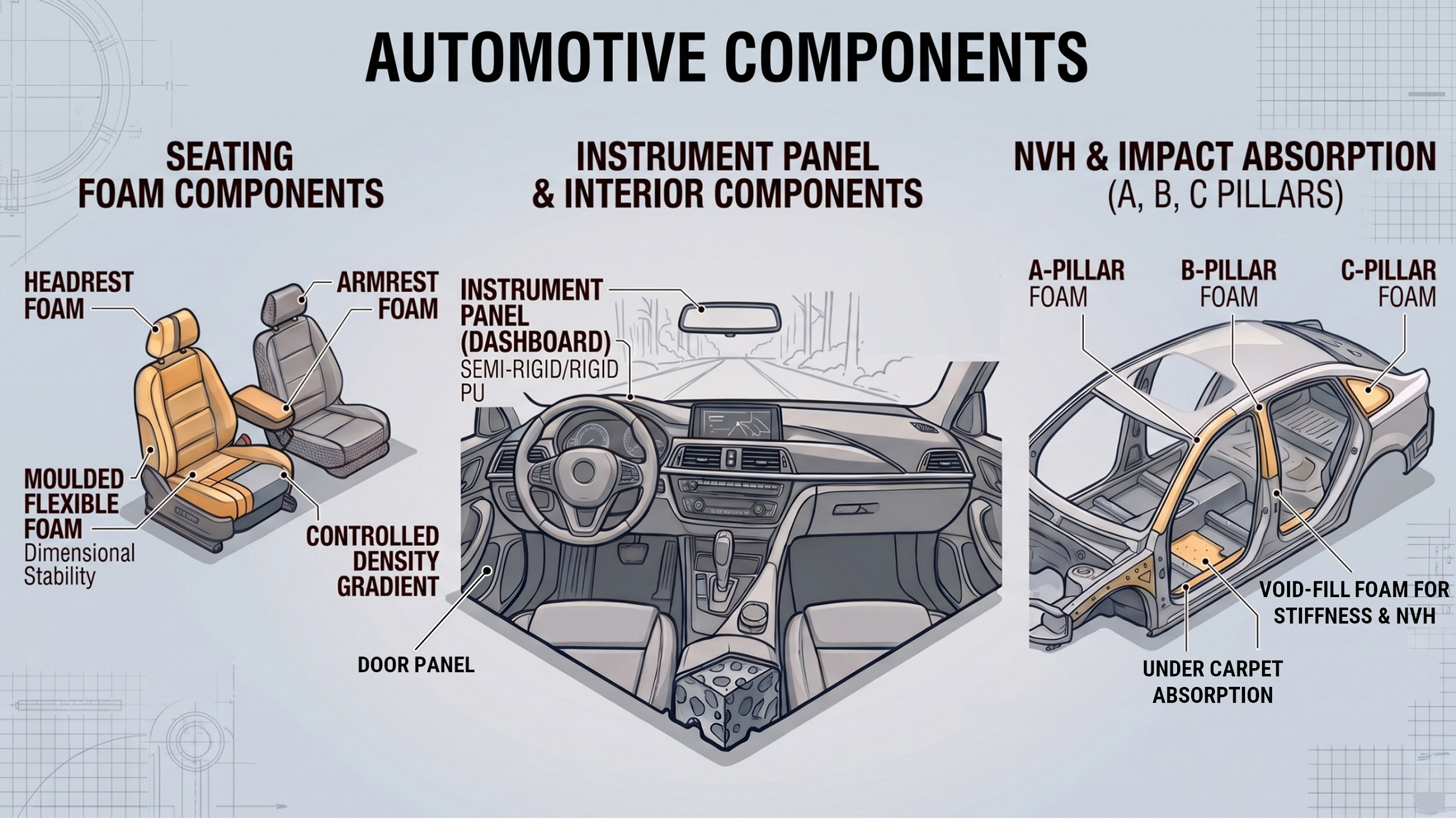
Automotive Components
PTU MDI-Based Polyurethane Systems
Polyurethane is widely used throughout the automotive industry in applications ranging from seating and interior components to acoustic insulation and NVH (Noise, Vibration and Harshness) management.
PTU supplies and develops MDI-based polyurethane chemical systems used by automotive component manufacturers to produce a wide range of finished parts. Depending on the application, these may include moulded flexible foam for headrests, armrests and seat components; semi-rigid and rigid PU systems for instrument panels and interior components; and specialised PU systems for NVH applications such as dash insulators, under-carpet insulation and other acoustic components.
PTU works with customers to develop formulations suited to specific processing methods, component designs and performance requirements. Systems can be formulated to provide the required balance of comfort, resilience, stiffness, dimensional stability, adhesion, acoustic performance and other application-specific properties.
PTU’s technical capability is supported by extensive automotive polyurethane experience. PTU founder Colin Groom began his career in the polyurethane industry working with automotive component manufacturers before spending more than 20 years providing technical service and formulation support for polyurethane systems across a wide range of automotive component applications.
Product Features
Application-Specific Performance
PTU polyurethane systems can be formulated to provide the required combination of flexibility, support, resilience, stiffness and dimensional stability for different automotive components and operating conditions.
NVH and Acoustic Applications
Selected PU systems can contribute to noise and vibration control in vehicle interiors, including applications such as dash insulators, under-carpet insulation and other acoustic components.
OEM and Regulatory Requirements
PTU works with customers to develop formulations designed to meet specified automotive OEM, regulatory and application requirements, subject to the relevant testing and qualification procedures.
Low-Emission Formulation Options
Where required, PTU can select raw materials and formulation technologies with the objective of controlling VOC and other emissions, supporting customer requirements for vehicle interior air quality.
Composite Moulding
Polyurethane systems can be formulated to work with a range of reinforcement materials and inserts, allowing manufacturers to produce composite components with integrated metal or other inserts.
Reinforced and High-Density Formulations
Selected formulations can incorporate mineral fibres or other reinforcing materials to increase stiffness and support dimensional stability. Mineral fillers such as barium sulphate can also be used where increased density and mass are required for specific acoustic applications.
Adhesion to Coverings and Substrates
When correctly formulated and processed, polyurethane systems can provide good adhesion to suitable decorative coverings, substrates and inserts. During moulding, the liquid PU system will wet the contacting surfaces and, where the chemistry and surface conditions are appropriate, develop a strong bond as the material reacts and cures.
Integrated Part Manufacture
The ability to mould polyurethane directly against suitable substrates, coverings and inserts can enable manufacturers to combine cushioning, structural and decorative functions within a single finished component, potentially simplifying part construction and assembly. PTU doesn't simply offer a standard foam; PTU works with the component manufacturer to formulate the PU system around the part design, production process, substrate, reinforcement and required performance.