

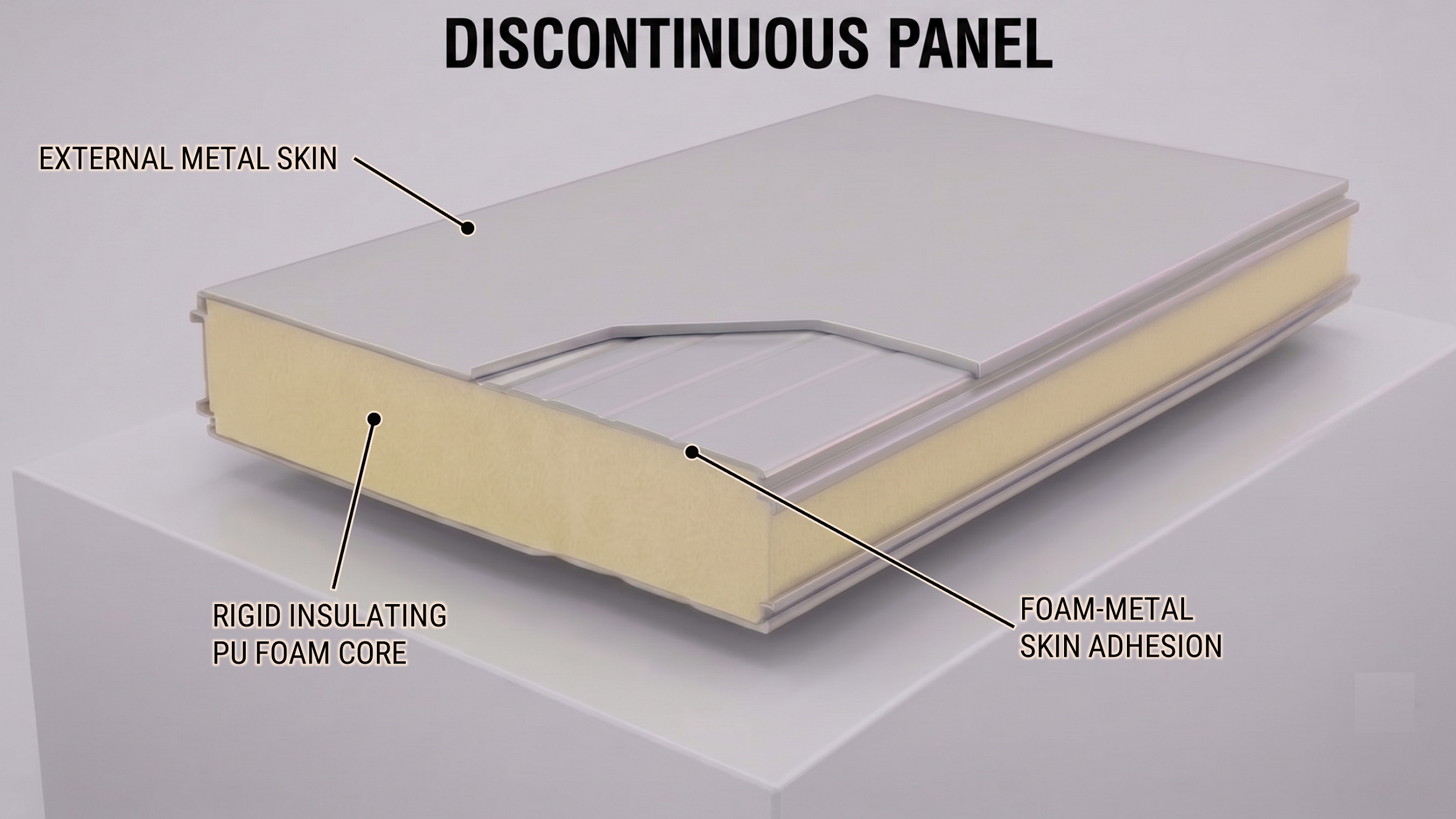
Discontinuous Panel
PTU RF Series — Rigid PUR & PIR Foam Systems
PTU supplies formulated rigid polyurethane chemical systems used by panel manufacturers to produce insulated composite panels through the discontinuous panel process.
In this process, rigid polyurethane foam is formed between facing materials such as steel sheet, cement board, fibreboard, aluminium foil or other suitable substrates. The facings are positioned within a press, and the PTU foam system is dispensed or injected into the cavity, where it reacts and expands to form an insulating core that bonds to the facings.
Panel dimensions and construction are determined by the manufacturer’s press equipment, tooling and application requirements. PTU can develop and supply PUR and PIR foam systems to suit specific panel designs, target densities, thermal performance requirements and processing conditions.
Discontinuous insulated panels are used in applications including cold rooms, cold storage facilities, clean rooms and other temperature-controlled environments. Depending on the panel design and structural construction, they may also be used in building and modular construction applications.
Product Features
High Thermal Insulation Performance
Rigid PUR and PIR foam systems can provide low thermal conductivity, helping reduce heat transfer and improve the energy efficiency of insulated buildings and temperature-controlled facilities.
Lightweight Insulating Core
The low-density foam core provides effective thermal insulation without adding unnecessary weight, supporting efficient handling and installation of finished panels.
Moisture Resistance
Closed-cell rigid polyurethane foam provides good resistance to moisture penetration, supporting the long-term insulation performance of suitably designed and manufactured panels.
Durable Performance
PTU foam systems can be formulated to provide the combination of thermal, mechanical and dimensional properties required for specific panel applications and service conditions.
Considered Blowing-Agent Technology
PTU selects blowing-agent technologies appropriate to the application and regulatory requirements, including technologies with zero ozone depletion potential and reduced global warming impact where applicable. The resulting insulation performance may also contribute to energy-efficiency objectives and, where applicable, support the requirements of relevant green building standards or certification schemes.